AASCU Federal Highlights – October 2025
A compilation of policy news shared in AASCU’s Weekly Federal Policy Update.
Subscribe now.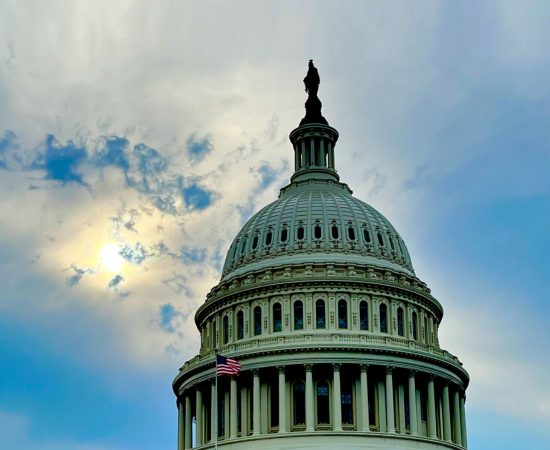
October’s Lead Story
Federal Government Shuts Down
The Federal government officially shut down for the first time since 2019, after Congress failed to reach a funding agreement for fiscal year 2025. About 95% of U.S. Department of Education (ED) employees not involved in Federal student aid have been furloughed without pay, with only a limited number expected to return if the shutdown lasts more than a week.
Read more.Other news and resources
October Documents & resources
From the week of Oct. 2
Federal Government Shuts Down
On Wednesday, the Federal government officially shut down for the first time since 2019, after Congress failed to reach a funding agreement for fiscal year 2025. About 95% of U.S. Department of Education (ED) employees not involved in Federal student aid have been furloughed without pay, with only a limited number expected to return if the shutdown lasts more than a week. While core student aid functions like Pell Grant disbursements, student loan payments, Free Application for Federal Student Aid (FAFSA) access, and Federal Student Aid Information Center access will continue, the Department has paused grantmaking and civil rights investigations. Higher education institutions may experience limited immediate impact, but extended disruptions could affect research funding, communication with Federal agencies, and visa processing. Institutions should prepare for delays and backlogs once normal operations resume. AASCU will continue to report on developments in the Department’s functions as well as ongoing Congressional negotiations.
Chair Cassidy Releases RFI on College Costs and Transparency
On Tuesday, Senate Health, Education, Labor, and Pensions Committee Chair Bill Cassidy (R-LA) released a Request for Information (RFI) seeking stakeholder input on ways to improve transparency in higher education and reduce costs for students and families. The RFI focuses on four main areas: price transparency, value transparency, clarity in financial aid offers, and informed student borrowing. It highlights challenges such as hard-to-navigate net price calculators, limited program-level earnings data, misleading financial aid letters, and student confusion around loan terms. The RFI invites feedback on potential bipartisan policy solutions to ensure students have the information needed to make better-informed,cost-conscious decisions about where and what to study. Comments are due by Friday, October 24, 2025.
ED Holds Negotiated Rulemaking Sessions on Student Loans
This week, ED held its first Reimagining and Improving Student Education (RISE) Committee negotiated rulemaking sessions, focused on proposed regulations tied to student loan provisions in the One Big Beautiful Bill Act (H.R. 1). Topics in discussion included reforms to Public Service Loan Forgiveness (PSLF), Direct Loan borrowing limits, Income-Driven Repayment plans such as Pay As You Earn (PAYE) and Income-Contingent Repayment (ICR), as well as provisions related to loan deferment, forbearance, and rehabilitation. The Department has remained largely consistent with the proposals it initially released. Notably, ED confirmed that the rulemaking sessions would proceed this week, despite the government shutdown, though if interrupted, the Committee could meet virtually from October 15-17.
Trump Administration Issues Compact to Nine Universities
As reported by the Wall Street Journal and the New York Times, the White House sent letters to nine universities yesterday outlining a compact that, if agreed to by the schools, would give them priority in receiving Federal funding and fewer constraints on administration and overhead costs. The New York Times reported that the compact would require colleges to freeze tuition for five years, cap the enrollment of international students, and adopt the Administration’s position on gender.
Additionally, universities would be required to “change their governance structures to prohibit anything that would ‘punish, belittle and even spark violence against conservative ideas’.” Lastly, the compact would also seek to have institutions provide free tuition to students studying math, biology or other hard sciences if a school’s endowment exceeds $2 million per undergraduate student. The institutions that reportedly received this communication are the University of Arizona, Brown University, Dartmouth College, Massachusetts Institute of Technology, the University of Pennsylvania, the University of Southern California, the University of Texas, Vanderbilt University, and the University of Virginia. AASCU will continue to follow these developments closely, as well as report on potential next steps.
From the week of Oct. 9
Update on Federal Government Shutdown
This week, the Federal government remains in a shutdown after Congress failed to pass a continuing resolution to fund operations into fiscal year 2026. There have been no major developments since AASCU last reported on this matter. Though, the latest news, according to media outlets, is that the Administration has drafted a memo arguing that Federal employees are not guaranteed back pay. Notably, this tactic has not led Democrats to change their position on funding the government. Extensions of Affordable Care Act subsidies remain the primary sticking point. AASCU will continue to monitor this issue closely.
Update on ED Negotiated Rulemaking Sessions Regarding Student Loans
Last week, the U.S. Department of Education (ED) concluded its first round of negotiated rulemaking sessions under the Reimagining and Improving Student Education (RISE) Committee. As a reminder, these sessions focused on regulations needed to implement the student loan provisions outlined in the One Big Beautiful Bill Act, including changes to Public Service Loan Forgiveness (PSLF), limits on Direct Loan borrowing, changes to Income-Driven Repayment (IDR) plans such as Pay As You Earn (PAYE) and Income-Contingent Repayment (ICR), and updates to loan deferment, forbearance, and rehabilitation provisions.
Negotiators did not reach a consensus during this round of sessions. The most contentious issue centered on how to define “professional” versus “graduate” programs. Several negotiators raised concerns about ED’s proposal to allow institutions a one-year transition period during which they could self-designate the classification of their programs. ED indicated that it will revise its regulatory proposal and present updated language for consideration at the next round of sessions, which are scheduled for November 3–7, 2025.
Confirmation of ED Nominees
On Tuesday, the Senate voted 51–47 to approve an en bloc amendment confirming more than 100 Trump Administration nominees. Among those confirmed were Kimberly Richey as Assistant Secretary for Civil Rights and David Barker as Assistant Secretary for Postsecondary Education.
From the week of Oct. 16
Federal Government Shutdown Continues
At present, the Federal government remains in a shutdown after Congress failed to pass a continuing resolution to fund operations into fiscal year 2026. Inside Higher Ed has reported that colleges and universities are facing increasing disruptions to research funding, delayed grant processing, and the unavailability of agency personnel for collaboration and compliance support due to the shutdown. This will likely be worsened by the mass agency reductions-in-force (RIFs) that were issued late last week once they become effective in the coming weeks.
On Friday, Office of Management and Budget Director Russell Vought announced that the Trump Administration has initiated RIFs across agencies, including the U.S. Department of Education (ED). Of the impacted offices, ED has shared with Congress that 64 staff from the Office of Postsecondary Education had been laid off, as well as 137 from the Office for Civil Rights. There has been bipartisan opposition to these RIFs, including from Senate Appropriations Committee Chair Susan Collins (R-ME) who stated that “Regardless of whether federal employees have been working without pay or have been furloughed, their work is incredibly important to serving the public.”
However, an end to the shutdown does not seem to be in sight, with Secretary of Education Linda McMahon posting on social media that “millions of American students are still going to school, teachers are getting paid, and schools are operating as normal. It confirms what the President has said: the federal Department of Education is unnecessary, and we should return education to the states.”
It is worth noting that on Wednesday, a district court judge issued a temporary restraining order to halt ongoing layoffs and prevent more than 30 agencies from issuing any new layoff notices. AASCU will continue to closely monitor and report on the status of the shutdown and Federal RIFs.
Updates on Campus Compact
This week, the Massachusetts Institute of Technology (MIT) became the first university to reject the Trump Administration’s “Compact for Academic Excellence in Higher Education,” shortly followed by the University of Pennsylvania and Brown University. As a reminder, the Administration has stated that the compact offers universities increased access to Federal funding and reduced regulatory oversight in exchange for implementing a series of actions.
These include a five-year tuition freeze, limits on international student enrollment, alignment with the Administration’s stance on gender, protections for conservative speech, and mandatory free tuition in hard sciences at institutions whose endowments exceed $2 million per undergraduate student. Relatedly, the Trump Administration has now extended the offer to all colleges and universities, framing it as a return to “Truth and Achievement” in higher education. Although formal invitations were initially sent to just nine institutions, the broader rollout came via a Truth Social post. The six remaining universities that initially received the 10-page compact have until Oct. 20 to respond and/or provide feedback.
From the week of Oct. 23
Government Shutdown Continues
This week, the Federal government remains in a shutdown after Congress failed to pass a continuing resolution to fund operations into fiscal year 2026. There have been no major developments since AASCU last reported on this matter. The Affordable Care Act subsidies continue to be the major point of contention between Democrats and Republicans. The subsidies are set to expire by the end of the year, and the open enrollment period for changing healthcare plans begins November 1. Because individuals will need time to adjust their coverage decisions if the subsidies are not extended, pressures to reach a funding agreement are increasing. AASCU will continue to monitor this matter closely.
ED Confirms Tax-Free Loan Forgiveness for Eligible 2025 Borrowers
The Department of Education (ED) has agreed to a deal, in a lawsuit filed by the American Federation of Teachers and some student loan borrowers, to continue forgiving student loan debt to borrowers who had qualified in 2025 after decades of repayment.
With the expiration of tax-free loan forgiveness provisions in the American Rescue Plan Act (ARPA) of 2021 at the end of 2025, borrowers who qualify for loan forgiveness starting in January 2026 will have to pay taxes on the amount of their debt relief. Earlier this year, ED had stopped processing loan forgiveness applications or accepting new applications, creating concern that processing delays would mean some qualifying borrowers wouldn’t receive forgiveness until 2026 and would be subject to the new tax burden.
Per the agreement, “The date a borrower becomes eligible to have their loans cancelled under the IBR, Original ICR, or PAYE plans constitutes the effective date of their loan discharge.” Though 2025 recipients won’t be charged federal income taxes, borrowers in several states may owe state income taxes on forgiven loans.
Administration Officials Met with University Leaders on Campus Compact
On Friday, the Administration held a virtual meeting with several universities that had not responded to the proposed Campus Compact at the time, including the University of Arizona, the University of Texas at Austin, Vanderbilt University, Dartmouth College, and the University of Virginia. Additional invitations were sent to Arizona State University, Washington University in St. Louis, and the University of Kansas. U.S. Education Secretary Linda McMahon described the meeting as “an important step toward defining a shared vision,” noting that participants had a “positive and wide-ranging conversation about the Compact.” However, following the discussion, both Dartmouth College and the University of Virginia declined to join the agreement. Dartmouth President Sian Leah Beilock explained in a letter that she did not believe “a compact — with any administration — is the right approach to achieve academic excellence.” Similarly, University of Virginia Interim President Paul Mahoney stated that the university wanted “no special treatment” regarding Federal funding and warned that “a contractual arrangement predicating assessment on anything other than merit will undermine the integrity of vital, sometimes lifesaving, research and further erode confidence in American higher education.”
University of Virginia Reaches Settlement with Justice Department
On Wednesday, the University of Virginia and the U.S. Department of Justice (DOJ) announced that they reached a settlement that would pause pending investigations at the university in exchange for compliance with directives outlined in DOJ’s July memo. As a reminder, this memo speaks to barring the use of race in hiring, admissions, and scholarship matters. The University of Virginia released the text of the agreement, marking the first time an agreement or settlement was reached with a public institution of higher education.
From the week of Oct. 30
Government Shutdown Continues
The Federal government remains in a shutdown this week after Congress failed to pass a continuing resolution to fund operations into fiscal year 2026. There have been no major developments since AASCU last reported on this matter.
In the coming weekend, funding is set to lapse for several key programs, including SNAP food assistance, WIC nutrition support for low-income mothers and infants, the Essential Air Service, and numerous Head Start programs. In addition, paychecks scheduled for Federal employees and military personnel this week are at risk. AASCU will continue to monitor and report on the situation closely.
ED Releases Final PSLF Rule
Earlier today, ED released a pre-published version of its final rule on Public Service Loan Forgiveness (PSLF). The published version is scheduled for release tomorrow, October 31. Effective next July, the rule amends the definition of “qualifying employer” to exclude organizations that engage in activities the Trump Administration deems as illegal, such as supporting terrorism, “aiding and abetting illegal immigration,” and supporting gender transition for minors. Through this move, ED argues, “The Trump Administration is rightsizing the program to ensure that PSLF benefits go only to borrowers employed by organizations that genuinely serve the public.”
Some groups are raising concerns that this rule will allow the Administration to target certain groups based on ideological differences and thereby limit important student loan relief for teachers, doctors, and other political servants. According to The Hill, lawsuits will soon ensue.
ED to Hold Second Round of Neg Reg Sessions on Student Loans Next Week
Next week, the U.S. Department of Education (ED) will be holding its second round of the RISE negotiated rulemaking sessions on student loans. As a reminder, the aim of this second—and final—round of sessions is to reach consensus on regulations that tie to the student loan provisions in the One Big Beautiful Bill Act. AASCU expects the definition of professional programs that allow higher borrowing levels as compared to graduate programs to continue to be the biggest issue affecting negotiators and whether consensus is achieved.
Federal Judge Extends Injunction on Shutdown-Related RIFs
On Tuesday, U.S. District Judge Susan Illston extended the injunction on the Trump Administration from conducting shutdown-related reductions-in-force indefinitely. As a reminder, Judge Illston previously issued a temporary restraining order to halt ongoing layoffs and prevent more than 30 agencies from issuing any new layoff notices. Judge Illston emphasized that this recent decision to extend the injunction was necessary to prevent “irreparable harm” to Federal employees and ensure that the Administration’s actions comply with statutory and constitutional limits.
AASCU and Other Higher Ed Orgs Send Letter Opposing H-1B Visa Changes to DHS
Last Thursday, AASCU and other higher education organizations wrote a letter to U.S. Secretary of Homeland Security Kristi Noem expressing concern over the September 19, 2025, Presidential Proclamation that would impose a new $100,000 fee on H-1B visa petitions. We asked that colleges and universities be exempt from this fee, noting that H-1B faculty, researchers, and staff are essential to teaching students, conducting research, and providing healthcare—especially in fields like engineering, computer science, and health professions. We also requested clarification on how the new fee would be implemented, including refund policies, processing timelines, and whether those changing from F-1 or J-1 visas would have to pay it. The letter emphasized that higher education already has an exemption from the H-1B lottery cap and urged the U.S. Department of Homeland Security to extend similar consideration to colleges and universities, given their critical role in educating and preparing the nation’s workforce.
