Congressional Earmarks/Member Directed Spending
Earmarks are provisions in federal spending bills that direct funds to specific local projects in their congressional district or state, organizations, or governments, bypassing competitive bidding processes. Known as “Community Project Funding” or “Congressionally Directed Spending,” they allow lawmakers to fund specific district projects.
Earmarks can help strengthen your college or university.
An earmark is authorized by a provision in a congressional appropriation bill that directs a specific amount of money to a specific entity for a project. These funds are not subject to formal competition within a federal agency or department.
Currently, no education requests for Community Project Funding (House) are being accepted. The only account in the Labor, Health and Human Services, and Education (Labor-HHS-ED) bill eligible for earmarks from House members is the Health Resources and Services Administration within the Department of Health and Human Services. The Senate accepts funding requests for the Education component of the L-HHS-ED appropriations bill. Submission deadlines for House or Senate appropriations bills are set by each chamber.
Growing Earmarks Success for RPUs
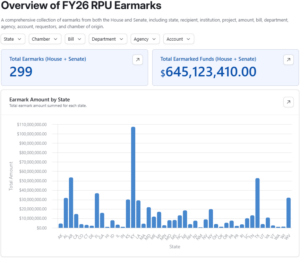
AASCU compiled an earmark funding resource outlining final fiscal year (FY) 2026 awards. This list tracks Congressionally Directed Spending (Senate) and Community Project Funding (House of Representatives) funding levels for all regional public universities (RPUs). The searchable spreadsheet and dashboard allow users to explore funding by federal department or agency, account, and bill to better understand funding priorities and inform FY27 proposal applications.
In FY26, 200 RPUs and systems received over $645 million in congressionally directed spending. Compared to 96 RPUs and systems receiving $293 million in funding in FY24.
$352M increase
In FY26, 200 RPUs and systems received over $645 million in congressionally directed spending, compared to 96 RPUs and systems receiving $293 million in funding in FY24.
All RPU leaders should approach a member of their congressional delegation to request funding for their institution.
Key Aspects of Earmarks
- Purpose: They fund specific projects such as local infrastructure, construction, equipment acquisitions, nonprofit support, or state/local government entities.
- Process: Reinstated in 2021 after a moratorium, they are now subject to increased transparency, requiring members to disclose their requests on their websites.
- Limits: Total earmark funding is typically limited to 1% of total federal discretionary spending.
- Types: “Hard marks” are legally binding in legislation, while “soft marks” are in committee reports.
- Controversy: Critics argue they promote wasteful “pork barrel” spending and potential corruption, while supporters argue they allow representatives to address specific local needs efficiently. Most members of Congress do not subscribe to this type of criticism. They firmly believe that Congress ultimately controls spending and that federal agency personnel do not know or understand local needs as well as a senator or representative does.
FY26 RPU Earmarks
A comprehensive collection of earmarks from both the House and Senate, including state, recipient, institution, project, amount, bill, department, agency, account, requestors, and chamber of origin.
Questions about earmarks? Let us know.
"*" indicates required fields
