Issue Summary
#PreservePell: A Proven Investment
AASCU joins fellow student aid advocates in calling on Congress to protect this proven investment and preserve current eligibility and award size.
No program authorized under the Higher Education Act of 1965 has had more success or impact than the federal Pell Grant. A proven program that has been the foundation of federal student aid for decades, the Pell Grant unlocks the doors of higher education and opportunity for students from low- and moderate-income backgrounds, with a maximum annual award of $7,395. Since 1972, more than 216 million students have received a Pell Grant. Undergraduates at regional public universities (RPUs), which comprise 520 four-year public colleges and universities, were more likely to be Pell recipients (38%) than undergraduates at non-RPUs (25%).
Pell Grants effectively create pathways for students to earn a degree, join the workforce, and achieve greater social and economic mobility. Yet, the maximum award has not kept up with the rising costs of postsecondary education or inflation for decades. Students today face challenges far beyond their control, but a greater increase to the federal Pell Grant is a sustainable, long-term solution.
If Congress chooses not to #PRESERVEPELL, the estimated $5.5 billion Pell Grant shortfall will result in decreased grant eligibility and/or cuts to award amounts.
Targeted and Means-Tested.
Since its inception more than half a century ago, the Pell Grant program has been a precise, well-tested federal benefit based primarily on a student’s expected family contribution and the cost of attendance (COA). Yet, it has not kept pace with inflation and the needs of today’s students. If Congress chooses not to address the estimated Pell Grant shortfall of $5.5 billion in FY26, it will decrease postsecondary access and affordability for current and future students with the greatest financial need.
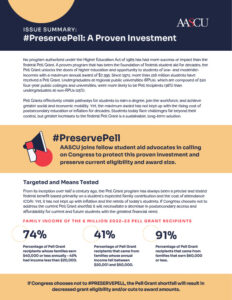
Family income of the 6 million 2022-23 Pell Grant recipients
74%
Percentage of Pell Grant recipients whose families earn $40,000 or less annually—43% had income less than $20,000
41%
Percentage of Pell Grant recipients that came from families whose annual income fell between $20,001 and $50,000
91%
Percentage of Pell Grant recipients that came from families that earn $60,000 or less.
Provider of opportunity.
The Pell Grant is especially critical to those Americans who make up the “new majority” of college students: low-income, first-generation, persons of color, working adults, and/or veterans. For these students, receiving a Pell Grant that doubles its current value can make the difference between an affordable opportunity and carrying debt when seeking a postsecondary education.
Who receives pell grants?
50–60% of students of color
Nearly 60% of Black students and roughly half of American Indian or Alaska Native and Hispanic or Latino students receive a Pell Grant each year.
50–56% of first-gen students and student parents
Attainment of a college education is possible for half of first-generation college students and 56% of student parents because of Pell Grants.
40% of veterans
Nearly 40% of student veterans are Pell Grant recipients.
Reduces debt, fights inflation.
The cost of college tuition and the debt it entails are widely recognized as the largest barriers to economic mobility and wealth generation for young Americans. While RPUs continue to provide a strong return on investment for students, families, and taxpayers, a steep decline in state and local investment, coupled with increased operating costs and decades-old infrastructure maintenance, has required tuition increases.
Preserving the Pell Grant is one of the most direct ways Congress can ensure the success of students today and tomorrow. The outcome is mutually beneficial, empowering both students and communities. Lawmakers can return some of the grant’s purchasing power by decreasing the need for burdensome and potentially high-interest loans that leave students and families drowning in debt.
47 percentage point drop
At its peak in 1975, the maximum Pell Grant covered 79% of tuition, room, and board for a public four-year institution. In AY2024-25, a maximum award would only cover 30% of costs.
55% increase in average award
Since 2000, the average Pell Grant awarded increased 55%, culminating in an average award of $4,500 in AY2019–20 for public four-year Pell recipients.
26% attendance cost covered
The present maximum Pell Grant in AY2021–22 covered only 26% of the cost of attendance at public four-year institutions.
Data sources
- AASCU analysis of National Postsecondary Student Aid Study: 2020 data.
- Ma, J., & Pender, M. (2024, October). Trends in College Pricing and Student Aid 2024.
- U.S. Department of Education. (2022-23). Federal Pell Grant Program End-of-Year Report and Other Annual Data Reports.
- U.S. Department of Education. (n.d.). Title IV Program Volume Reports: Grant Programs.
- National College Attainment Network. (2022, October 5). #DoublePell for College Affordability.
- National Association of Student Financial Aid Administrators. (2022, August). Issue Brief: Doubling the Maximum Pell Grant.
Questions about #PreservePell? Let us know.
"*" indicates required fields
