Student-Centered Course Scheduling: Removing Hidden Barriers to Student Success
With funding from Ascendium Education Group, AASCU is helping regional public universities redesign course scheduling systems to accelerate student progress and completion—and share proven strategies with the field.
View participating institutions. Access tools & resources.
OVERVIEW
A National Effort to Make Course Scheduling Work for Students
The Student-Centered Course Scheduling initiative supports 20 AASCU member institutions in transforming how courses are offered, sequenced, and staffed—so students can get the courses they need, when they need them, to stay on track to graduation.
Participating Institutions
- Funded by a $2.4 million grant from Ascendium Education Group
- Includes 20 regional public universities across the U.S.
- Technical Assistance provided by Ad Astra
- Builds on the proven success of an 11-institution pilot (2022–2024)
Why It Matters
A Hidden—but Critical—Lever for Student Success
At many institutions, the course schedule has become a structural barrier to completion. Misaligned offerings, scheduling conflicts, and outdated policies can delay graduation and increase costs for students. AASCU’s work helps colleges use data, policy, and collaboration to make the course schedule a strategic driver of completion and retention.
46%
Fewer than half of students at 4-year public institutions graduate within 4 years, with each additional semester of enrollment adding thousands in tuition and living costs, pricing many students out before they can finish their degree. (National Center for Education Statistics (NCES), 2024)
1.5x
Students who work 20+ hours per week are 1.5x more likely to delay a required course than peers who don’t work. (National Center for Education Statistics (NCES), 2022)
30%
Nearly one in three students report being unable to register for at least one required course each term, delaying their progress to graduation. (Ad Astra Institute, 2023)
20%
Roughly one in five courses at regional public universities operate below 70% of capacity, while others are overfilled—showing deep misalignment between course supply and student demand. (Ad Astra, 2022)

“The course schedule is the engine of degree completion. You simply cannot drive better outcomes without a course schedule designed with student success in mind.”
Our Approach
From Structural Barriers to Student-Centered Systems
AASCU, with technical assistance from trusted partners, supports participating institutions through four key strategies to improve degree velocity and student success:
- Elevate course scheduling as a student success strategy. Engage key stakeholders, including executive leaders, in a structured change management process that positions course scheduling as a cornerstone of student success.
- Implement sustainable policies and procedures. Conduct policy inventories and audits to ensure schedule-building practices and related policies align with institutional goals and priorities.
- Design student-centered, data-informed schedules. Use real-time data and degree velocity metrics to identify actionable improvements such as adding sections for high-demand or overloaded courses, resolving conflicts between required courses, or reducing high-DFW course combinations in the same term.
- Embed continuous improvement. Build long-term capacity by integrating ongoing reflection, measurement, and refinement into the scheduling process from the start.

IMPACT
Results from the Pilot
From 2022–2024, AASCU worked with 11 regional public universities in an earlier pilot project to test and refine this approach. The results were clear: smarter course scheduling leads to faster student progress and higher completion.
12%
increase in students completing first-year English and math courses (Fall 2022–Fall 2024)
1.4
credit increase in average productive credits earned per student annually (an 8.1% improvement)
In addition to these overall gains, individual institutions achieved measurable improvements in areas such as course access, classroom utilization, and student momentum. Examples include:
- Texas A&M University increased students taking 15+ credits per semester by 22 percentage points.
- Western Kentucky University improved their Overloaded Course Ratio by 25% in first-year courses .
- Texas A&M University–Corpus Christi boosted classroom utilization by 5% and reduced primetime compression by 11%.
- Texas A&M University-San Antonio increased overall primetime classroom utilization and reduced off-grid waste by 3 percentage points.
Explore the Course Scheduling Playbook for clear definitions of the key metrics used throughout this initiative.

“Whether it’s the Dean, the Chairs, the Registrar, any stakeholder, they now understand the importance of course scheduling and how it impacts a student’s ability to not only enter the university in a seamless manner, but also persist and eventually graduate.”

“This work has given us the data we’ve needed. Having data from an external source has added credibility, opened up very different ways of looking at our data, and helped us identify additional data we need moving forward.”

“Being part of the cohort gave me access to additional ideas and ways of thinking I may not have otherwise had. It gave us the tools we need to position ourselves for future success.”
Resources
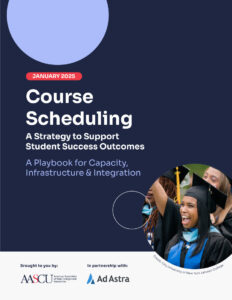
Course Scheduling Playbook
The playbook, created as a result of a previous initiative, is a guide for any institution interested in levering their course schedule as a strategy for improving student success. It introduces project phases designed to drive innovation and momentum, project management strategies, and relevant metrics, to support the teams empowered to do this work.
Student-Centered Course Scheduling Webinars
This webinar series shares practical tools, templates, and lessons from the Student-Centered Course Scheduling initiative to help institutions strengthen how schedules support student progress. Each session introduces a concrete resource you can take back and apply on your campus. While developed with AASCU member institutions, these webinars are open to all colleges and universities working to advance this work.
Apr. 27, 2026
2:00PM-3:00PM ET
Webinar
Register today.Jun. 12, 2026
1:00PM-2:00PM ET
Webinar
Register today.Jul. 30, 2026
1:00PM-2:00PM ET
Webinar
Register today.Sep. 3, 2026
2:00PM-3:00PM ET
Webinar
Register today.Supported by:

In partnership with:

Have questions about Student-Centered Course Scheduling? We’d love to hear from you.
Our team is here to support institutions exploring course scheduling reform and to connect those interested in future learning opportunities or resources from this work.
"*" indicates required fields
