AASCU Edge
Inside AASCU’s Rural Symposium:
Strategies for Student Success and Regional Growth
The 2026 symposium underscored AASCU’s ongoing commitment to supporting RSIs and to ensuring they remain central to the future of higher education.
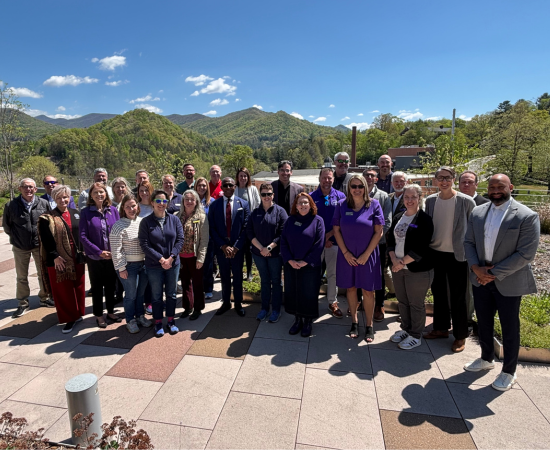
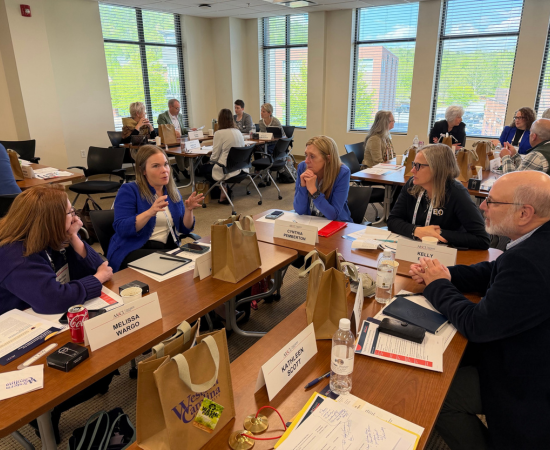
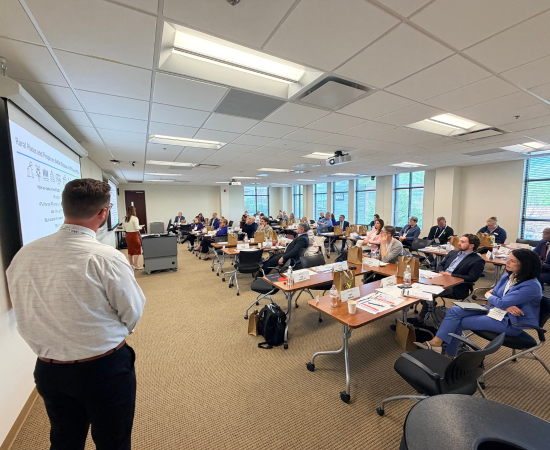
AASCU’s Transforming Local Communities Symposium brought together rural presidents and chancellors, campus leaders, researchers, and partners for two days of focused conversation on the future of rural-serving institutions (RSIs). Hosted by Western Carolina University (WCU) in Asheville, NC, the event combined campus immersion, policy discussion, and peer exchange to examine how institutions can strengthen student success, support regional economies, and respond to shifting public policy.
From the campus tour to the final strategy session, one message remained consistent throughout the symposium: RSIs are central to the vitality of their communities, and their role is only growing more important.
Grounding the Conversation in Place-Based Impact
Beginning with a campus tour of WCU’s campus in Cullowhee, NC, attendees took a firsthand look at how an RSI operates as a comprehensive community partner. Stops highlighted academic programs, research facilities, infrastructure investments, and the university’s connections to regional priorities like healthcare, public safety, and economic development.
That context was carried into the formal program, where speakers emphasized the place-based mission of RSIs. As Cynthia Pemberton, president of Lewis-Clark State College (ID) and chair of the AASCU Rural Presidents and Chancellors Committee, noted, “Our institutions allow us to anchor and grow talent for our communities.”
Leaders described how institutions contribute not only to education but also to job creation, capital investment, and regional planning. In many rural areas, they are deeply involved in addressing challenges around housing, childcare, technology access, and healthcare.
RSIs often serve as major employers and cultural hubs, hosting museums, small business development centers, and community programming. Data shared during the symposium reinforced their impact, linking rural regional public universities (RPUs) to higher per capita income, increased bachelor’s degree attainment, and stronger social outcomes in the regions they serve.
Affordability as Access and Institutional Responsibility
$500 per semester
In-state tuition set at institutions participating in the NC Promise plan.
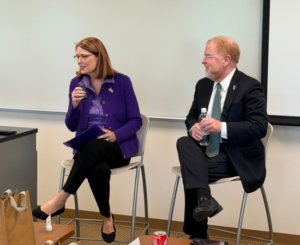
A fireside chat featuring University of North Carolina System President Peter Hans and WCU Chancellor Kelli Brown highlighted how system-level leadership can support access and student success at scale.
Hans pointed to a sustained focus on affordability, including targeted initiatives like the NC Promise program. At participating institutions, in-state tuition is set at $500 per semester, with the state covering the remaining cost. The result is lower tuition for students and an approach that has helped drive enrollment, retention, and completion. Nearly half of students at participating institutions graduate without institutional debt, and those who do borrow carry relatively low balances.
Institutions are also investing in student support systems, including stronger advising models, expanded partnerships with community colleges, and policies like common course numbering to simplify transfer pathways.
The emphasis on support reflects a key challenge facing rural higher education: While rural students graduate high school at high rates, they are less likely to complete college. Addressing that gap requires sustained, coordinated efforts across the student lifecycle.
Student Success Through Collaboration
The Rural Student Success Network (RSSN), highlighted during the “Partnerships That Matter” session, brings together 17 institutions across 12 states to assess and scale student success initiatives tailored to rural contexts. Its work focuses on three primary areas: transfer to bachelor’s programs, adult reengagement, and workforce-aligned education.
RSSN participants are developing and testing a range of approaches. Some are implementing proactive advising models with smaller caseloads and more personalized support. Others are expanding direct admissions programs, offering scholarships, and building wraparound services to address barriers beyond the classroom.
Examples shared during the session illustrate how the strategies are taking shape. At East Tennessee State University, a new advising model inspired by student-athlete support has improved retention through intensive, relationship-based guidance. At SUNY Oswego, a long-term initiative aims to double credential attainment by 2040, supported by admissions, financial incentives, and ongoing student tracking.
These efforts are complemented by broader regional partnerships. Institutions are working with K–12 systems, community colleges, and employers to create clearer pathways into and through higher education.
Connecting Education to Workforce Needs
RSIs are well positioned to design programs that reflect regional economic needs while providing students with viable career opportunities with local employers. Many are using labor market data to identify gaps and develop programs in high-demand fields, including health care, education, and applied technical disciplines.
At the same time, speakers acknowledged structural constraints. In healthcare, for example, demand for nursing programs often exceeds available capacity due to licensure requirements and limited clinical placements. While rural clinical experiences can encourage students to remain in their communities, competition with urban opportunities influences outcomes.
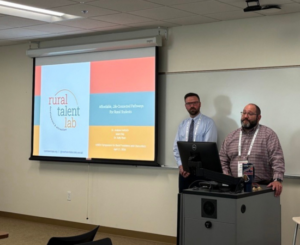
New approaches are emerging to address these challenges. The Rural Talent Development and Attraction Lab, a collaboration among national organizations and state partners, is focused on developing middle-skill pathways—credentials below the bachelor’s degree that lead to stable, well-paying jobs. These programs are designed to be flexible and stackable, allowing students to build toward a degree over time.
Even as institutions tackle workforce alignment, speakers emphasized the need to maintain a broader view of higher education’s purpose. As Hans stated during the fireside chat, “Higher ed matters to the economy, culture, society, and democracy,” a reminder that the value of postsecondary education extends beyond immediate job outcomes.
Policy Pressures, Federal Funding, and Public Perception
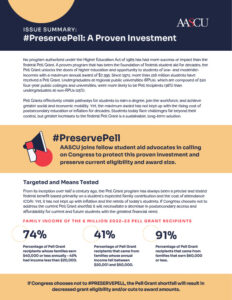
A session on rural RPUs and federal policy highlighted concerns about the long-term sustainability of the Pell Grant program. While recent FAFSA simplification efforts have improved access, projections indicate a significant funding shortfall in the coming years. For RSIs and the students they serve, any reduction in Pell support would have serious implications.
Healthcare policy also emerged as a critical issue. Proposed changes to Medicaid funding could affect rural communities, where hospitals often operate on narrow margins and play a central role in local economies. Reductions in funding could limit access to care while exacerbating workforce shortages.
New federal accountability measures tied to program-level outcomes are also reshaping expectations for institutions. Participants noted that metrics based on postgraduate earnings may have uneven impacts across disciplines, particularly in the humanities and arts.
Research presented during the “State of Rural-Serving Institutions and Public Perspectives on Higher Education” session explored how rural communities view postsecondary education. Findings from the Citizens’ Attitudes on Postsecondary Education (CAPE) project suggest that rural residents are more likely to question the value of a college degree and express concerns about student debt.
Some respondents also indicated a belief that higher education can distance individuals from their communities. These perceptions underscore the importance of local engagement and clear communication about the role institutions play in supporting regional vitality.
Data, Narrative, and Institutional Strategy
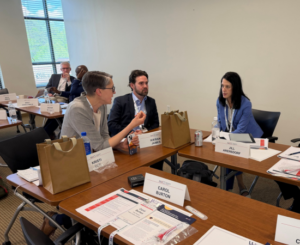
Sessions also explored how institutions can use data to strengthen their positioning and communicate their impact more effectively to policymakers, boards, and the public. A presentation from Fort Hays State University (KS) and Gray Decision Intelligence highlighted the role of data systems in aligning academic programs with institutional strategy and governing board priorities.
Leaders noted the importance of building buy-in across academic teams and ensuring that data is used as a tool for collaboration rather than compliance. When implemented effectively, these systems can help tell a more compelling story about their value and guide decision-making in a complex environment.
Looking Ahead
The symposium concluded with the “AASCU Rural Strategy Practice Exchange,” which focused on shaping the association’s rural strategy and advocacy efforts. Participants identified key priorities for the future, including workforce development, sustainability, student and faculty recruitment and retention, technology, and artificial intelligence.
As Appalachian State University’s (NC) Adam Ray put it, “Everywhere is somewhere to people who live there.” Ray’s perspective captures the essence of the symposium: A recognition that rural communities matter, and the institutions serving them are essential to their continued growth and resilience.
By bringing leaders together to share insights, examine data, and build partnerships, the Transforming Local Communities Symposium underscored AASCU’s ongoing commitment to supporting RSIs and to ensuring they remain central to the future of higher education.
Want more posts from AASCU Edge?
Questions about our symposium? Let us know.
"*" indicates required fields
