Bridging Student Readiness Gaps
Join experts from EAB for a discussion on the student readiness crisis.
Join experts from EAB for a discussion on the student readiness crisis.
There is no excerpt because this is a protected post.
This event will explore the critical role of RPUs in mitigating local teacher shortages.
AASCU President Charles Welch writes on higher education and public institutions.
Reflections on higher ed changes over the past 30 years and perceived public value.
Reflections on higher ed changes over the past 30 years and perceived public value.
Welch spoke at the Social Mobility Symposium, hosted by CSU San Marcos.
Aspen Institute and AASCU Announce Cohort 4 of the Transfer Student Success Intensive
Strada Education Foundation awards recipients in partnership with AASCU and APLU.
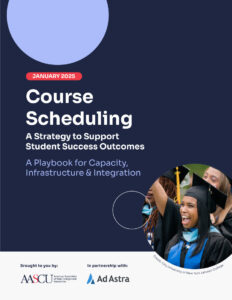
An initiative designed to elevate the importance of the course schedule and leverage it to improve student outcomes in higher education.
Contact us to learn more.One of the most essential elements to a student’s academic success is getting the courses they need to complete their degree. Yet, research indicates that at most institutions, the course schedule has become a structural barrier to success.
AASCU received funding from The Ascendium Education Group to improve course scheduling and ensure that access to courses required for degree completion is not a barrier to success, especially for low-income students and students of color.
Created in partnership with Ad Astra, the project included: two convenings, monthly webinars, benchmarking with technical assistance, data coaching, and change management consulting for eleven institutions. These structured engagements supported institutional capacity for data-informed course scheduling and improved scheduling policies and practices.
Through this work, institutions have identified actionable strategies to:
For students starting in Fall 2023, there was an 8% increase in the overall momentum year rate, with rates for Native American, Black/African-American, Hispanic, and Native Hawaiians having an average increase of between 7% and 13%.
The average annual productive credits increased by 1% for students starting in Fall 2023 as opposed to students beginning in Fall 2022.
Had an increase of students taking 15+ credits per semester from 23% in fall 2023 to 45% in fall 2024.
Had 25% improvement in the Overloaded Course Ratio, specifically in first-year (100-level) courses, between fall 2023 and fall 2024.
From fall 2023 to fall 2024, classroom utilization increased by 5%, while Primetime Compression decreased by 11%; in Fall 2024 Off-Grid Waste decreased over two percentage points compared to Fall 2023.
From fall 2023 to fall 2024, overall primetime utilization increased in classrooms while off-grid meeting pattern utilization decreased by 10% and off-grid waste decreased by three percentage points.

The playbook, created as a result of this initiative, is a guide for any institution interested in levering their course schedule as a strategy for improving student success. It introduces project phases designed to drive innovation and momentum, project management strategies, and relevant metrics, to support the teams empowered to do this work.

"*" indicates required fields
This content is for GRC members only. If you are a GRC member, please click the Login button to access the content.
If your institution is already a GRC member, request your username and password information here.
Request credentials.Contact GRC to discuss membership benefits at GRCmembership@aascu.org or 202-478-7810.
Learn more.