Transforming Local Communities
A symposium for leaders of rural institutions to connect and discuss their unique role.
A symposium for leaders of rural institutions to connect and discuss their unique role.
Join AASCU’s annual in-person Hill Day and make your voice heard in the halls of Congress.
Lumina Foundation, in partnership with AASCU and national intermediaries, is supporting institutions in scaling and institutionalizing career-connected high-impact practices (HIPs)—transformative educational experiences that deepen learning, boost degree completion, and prepare students for meaningful careers. This national initiative goes beyond grant support—it offers the chance to shape national practice, join a peer learning community, and access technical assistance from experts in the field.
Contact us.
What if every student left college with the skills, experience, and confidence to thrive in today’s workforce? Career-connected high-impact practices – such as internships, undergraduate research, study abroad, service learning, and capstone projects – are powerful tools to make that vision real. These experiences not only deepen learning and boost degree completion, but when intentionally aligned with career pathways, they also help ensure every student is prepared for a meaningful career.
Learn more about this national initiative at Lumina Foundation.The initiative is implemented in partnership with AASCU, Excelencia in Education, and the Center for Innovation in Postsecondary Education (CIPE).
*institutions directly supported by AASCU
Lumina Foundation's press release.Career-connected HIPs aren’t optional extras — they are high-impact, equity-driven components of a student’s journey. When intentionally aligned with career pathways and workforce needs, these experiences help ensure all students graduate with the skills, confidence, and networks to thrive in a rapidly changing world.
High-impact practices are teaching and learning approaches that promote deep, meaningful learning by engaging students in active, applied, and reflective experiences. They help students integrate knowledge, build skills, and strengthen academic success and long-term growth. Among them are common intellectual experiences, diversity and global learning, first-year experiences, collaborative projects, writing-intensive courses, community-based learning, and undergraduate research.
Lumina Foundation is seeking letters of interest for a grant opportunity for up to 15 institutions to scale career-connected HIPs on their campuses. Applicants must seek to pursue ambitious and innovative HIPs strategies, but the benefits extend far beyond the direct funding to support this work, including:
Only institutions that meet the following criteria will be considered:
Priority consideration will be given to the following:
"*" indicates required fields
Ithaka S+R is collaborating with AASCU to gather a set of institutions seeking to share strategies, strengthen student success programs, and align academic offerings with local workforce needs.
Contact us.Rural-serving institutions are engines of opportunity and vital to their communities. Yet, many face unique challenges: shifting demographics, declining enrollment, and limited resources. Boosting enrollment, improving student outcomes, and aligning degree offerings with local and regional labor market needs can help, but many rural-serving institutions need additional support to tackle these challenges together.
To offer this support, Ithaka S+R, in collaboration with the American Association of State Colleges and Universities (AASCU), is launching the Rural Student Success Network. Through technical assistance, capacity building, and peer connection, this new initiative will help rural-serving institutions share strategies, strengthen student success programs, and align academic offerings with local workforce needs. The lessons learned from this network will generate actionable insights that can benefit rural-serving institutions across the country.
The Rural Student Success Network is supported through ECMC Foundation’s Rural Impact Initiative, which is dedicated to improving postsecondary access and success in rural communities with an emphasis on building institutional capacity, deepening understanding of the strengths and challenges of rural-serving institutions, and advancing strategies that increase completion rates. The Network and the efforts of its participants are an extension of this vision and promise to expand postsecondary opportunities for rural learners everywhere.
Learn more about this program at Ithaka S+R.Participation in the student success network will provide institutions with key resources to propel their student success goals forward and support degree attainment. Participating institutions will also contribute to key insights for a case study report and summative brief, which will highlight best practices and provide a roadmap for similar institutions looking to maximize student success and grow in the three focus areas.
The 18 selected institutions will form a cohort dedicated to contributing to shared knowledge pertaining to student success, developing systems for self-assessment and continuous improvement, and tailoring institutional approach to student outcome and economic data. The benefits for participants include:
The cohort members will engage in the network through virtual and in-person convenings, participate in quarterly virtual one-on-one check-ins with the Ithaka S+R team, and learn from both existing research and project insights. Institution-specific reports will examine educational and economic outcomes based on available institutional, state, and federal data. Ithaka S+R will draft and publish a public case study report and summative brief at the end of the grant period to provide a framework for other rural-serving institutions looking to maximize student success and completion.
Each selected institution will receive a $15,000 subgrant from Ithaka S+R to support staff participation in project activities, which include data sharing, convening attendance, and self-assessment activities.
Please submit written responses to these three questions:
Your responses along with a letter of support from your institution’s president should be submitted through this online form by October 3, 2025. A selection decision will be made and communicated by October 14, 2025 following project team review.
Note: We estimate that the time commitment for providing relevant programmatic information and completing self-assessment activities is approximately eight hours, which should include collaboration between senior leaders and program administrators. Beyond this, institutions have the flexibility to engage as deeply as their capacity allows in individualized technical assistance and customized data reporting provided by Ithaka S+R.


"*" indicates required fields
Learn about the RSN project and the associated RFP process.
A starter kit for campus leaders.
A readiness guidebook for campus leaders.
AASCU is helping colleges and universities redesign course scheduling systems to accelerate student progress and completion—and share proven strategies with the field. This work is made possible through funding from Ascendium Education Group and Lumina Foundation, with additional support from the Gates Foundation.
View participating institutions. Access tools & resources.
The Student-Centered Course Scheduling initiative supports 35 AASCU member institutions in transforming how courses are offered, sequenced, and staffed—so students can get the courses they need, when they need them, to stay on track to graduation.
Institutions take part through one of the three groups: a founding pilot (Cohort 1), a multi-year cohort (Cohort 2), and a faster-paced accelerator program.
Cohorts 1 and 2 are funded by Ascendium Education Group. Cohort 1 was an 11-institution pilot that tested this approach before scaling, and Cohort 2 carries the work forward with 20 regional public universities receiving multi-year intensive technical assistance. The Accelerator program, funded by Lumina Foundation with additional support from the Gates Foundation, brings the same student-centered scheduling strategies to 12 more colleges.
At many institutions, the course schedule has become a structural barrier to completion. Misaligned offerings, scheduling conflicts, and outdated policies can delay graduation and increase costs for students. AASCU’s work helps colleges use data, policy, and collaboration to make the course schedule a strategic driver of completion and retention.
Fewer than half of students at 4-year public institutions graduate within 4 years, with each additional semester of enrollment adding thousands in tuition and living costs, pricing many students out before they can finish their degree. (National Center for Education Statistics (NCES), 2024)
Students who work 20+ hours per week are 1.5x more likely to delay a required course than peers who don’t work. (National Center for Education Statistics (NCES), 2022)
Nearly one in three students report being unable to register for at least one required course each term, delaying their progress to graduation. (Ad Astra Institute, 2023)
Roughly one in five courses at regional public universities operate below 70% of capacity, while others are overfilled—showing deep misalignment between course supply and student demand. (Ad Astra, 2022)

AASCU, with technical assistance from trusted partners, supports participating institutions through four key strategies to improve degree velocity and student success:

From 2022–2024, AASCU worked with 11 regional public universities in a pilot project to test and refine this approach. The results were clear: smarter course scheduling leads to faster student progress and higher completion.
increase in students completing first-year English and math courses (Fall 2022–Fall 2024)
credit increase in average productive credits earned per student annually (an 8.1% improvement)
In addition to these overall gains, individual institutions achieved measurable improvements in areas such as course access, classroom utilization, and student momentum. Examples include:
Explore the Course Scheduling Data Guide for clear definitions of the key metrics used throughout this initiative.


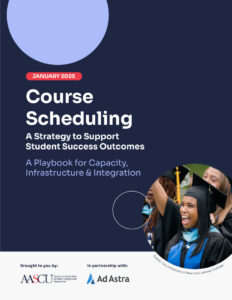
The playbook, created as a result of the cohort 1 pilot, is a guide for any institution interested in levering their course schedule as a strategy for improving student success. It introduces project phases designed to drive innovation and momentum, project management strategies, and relevant metrics, to support the teams empowered to do this work.
This webinar series shares practical tools, templates, and lessons from the Student-Centered Course Scheduling initiative to help institutions strengthen how schedules support student progress. Each session introduces a concrete resource you can take back and apply on your campus. While developed with AASCU member institutions, these webinars are open to all colleges and universities working to advance this work.
Sep. 3, 2026
2:00PM-3:00PM ET
Webinar
More information.Jul. 30, 2026
1:00PM-2:00PM ET
Webinar
More information.Jun. 12, 2026
1:00PM-2:00PM ET
Webinar
More information.Apr. 27, 2026
2:00PM-3:00PM ET
Webinar
More information.

Our team is here to support institutions exploring course scheduling reform and to connect those interested in future learning opportunities or resources from this work.
"*" indicates required fields
Initiative to provide nearly $1M in technical assistance and financial support.
This content is for GRC members only. If you are a GRC member, please click the Login button to access the content.
If your institution is already a GRC member, request your username and password information here.
Request credentials.Contact GRC to discuss membership benefits at GRCmembership@aascu.org or 202-478-7810.
Learn more.