AASCU Edge
What the FY27 House Labor-HHS-Education Bill Means for Higher Education
Breaking down the bill’s mixed picture for higher education.
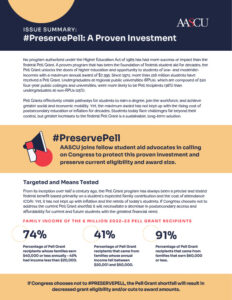
The House Appropriations Committee’s FY2027 Labor-HHS-Education (Labor-H) bill would reduce overall discretionary spending by about 3% below FY26 levels and cut funding for the Department of Education by roughly 10%. For higher education, however, the proposal presents a mixed picture. The bill largely protects the Pell Grant program, provides a modest increase to the maximum award, addresses the program’s looming funding shortfall, and preserves key college access programs such as TRIO and Gaining Early Awareness and Readiness for Undergraduate Programs (GEAR UP). At the same time, it would significantly reduce funding for campus-based aid programs and eliminate funding for subsidized federal student loans.
The proposal includes both investments and reductions.
Key provisions include:
- Increasing the maximum Pell Grant award by $50, from $7,395 to $7,445
- Providing more than $15 billion in mandatory funding to address the Pell Grant shortfall
- Preserving TRIO, GEAR UP, Postsecondary Student Success Grants (PSSG), and Hawkins Centers of Excellence
- Reducing Federal Work-Study (FWS) and Federal Supplemental Educational Opportunity Grant (FSEOG) funding
- Eliminating funding for subsidized Direct Loans for undergraduate students and the Teacher Quality Partnership (TQP) program
- Continuing support for historically Black colleges and universities (HBCUs), Hispanic-Serving Institutions (HSIs) and other Minority-Serving Institutions (MSIs) through Title III and Title V programs
Why It Matters
While the proposal would reduce overall funding for the Department of Education, it largely preserves federal grant aid that helps students access and afford college. The bill would increase the maximum Pell Grant award, address the program’s projected funding shortfall, and maintain support for college access programs such as TRIO and GEAR UP. However, institutions that rely heavily on campus-based aid programs, including FWS and FSEOG, could face significant funding reductions.

How Student Aid Programs Would Be Affected
View the House committee report, including complete program-level funding tables prior to amendments. The figures below reflect the amounts provided by that initial report.
| Program | FY26 Funding | FY27 House Proposal |
|---|---|---|
| Pell Grant Maximum Award | $7,395 | $7,445 |
| Pell Grant Discretionary Funding | ~$22.5 billion | ~$22.7 billion |
| Pell Shortfall Funding | No major supplemental appropriation | >$15 billion mandatory funding provided |
| FWS | ~$1.23 billion | Reduced by more than 25% |
| FSEOG | ~$910 million | Reduced by nearly 40% |
| TRIO | Level-funded in FY26 | Small increase (~$6 million) |
| GEAR UP | Level-funded in FY26 | Preserved/near level funding |
| Hawkins Centers of Excellence | $15 million | Preserved/level-funded |
| TQP | ~$70 million | Funding eliminated |
| PSSG | $45 million | Preserved/level-funded |
| Child Care Access Means Parents in School (CCAMPIS) | $75 million | Preserved/level-funded |
| Subsidized Direct Loans | Existing program funded | Funding eliminated |
Policy Provisions to Watch
Graduate Nursing Designated as a Professional Degree
An amendment offered by Chairman Robert Aderholt (R-AL) explicitly designates graduate nursing programs as professional degrees, restoring the higher $200,000 borrowing limit despite the lack of coordination with, or approval of, the House Education and Workforce Committee.
New Requirements Related to Antisemitism and Religious Organizations
Prohibits funding for schools that support antisemitic conduct or discriminate against religious student organizations. The provision could have implications for institutional compliance and campus policies.
Returning Education to the States Framework
The committee describes the bill as advancing efforts to reduce the federal role in education and shift authority toward states and institutions.
Elimination of Subsidized Student Loan Funding
The committee describes the bill as advancing efforts to reduce the federal role in education and shift authority toward states and institutions.
Restrictions Associated with Federal Funding
Maintains longstanding federal appropriations riders, including the Hyde Amendment and related provisions that affect federally funded institutions and programs.
Notable Amendments Accepted During Committee Markup
Several notable changes emerged as the bill moved through subcommittee and full committee consideration:
Accepted / Reflected in the Committee-Approved Bill
- Added funding to fully address the Pell Grant shortfall
- Increased the maximum Pell Grant award by $50
- Recognized graduate nursing degrees as professional degrees subject to the higher loan limits
- Preserved TRIO and GEAR UP despite earlier proposals to eliminate them
- Included a modest increase for TRIO programs
- Rejected proposals that would have eliminated FSEOG, FWS, and several college-access programs.
Significant Reductions Retained
- FSEOG funding cut by approximately 40%
- FWS funding cut by more than 25%
- Subsidized Direct Loan funding eliminated
What This Means for Colleges and Universities
For colleges and universities, the FY27 House Labor-H bill sends a mixed message. It demonstrates continued bipartisan support for Pell Grants by increasing the maximum award and addressing the program’s funding shortfall, while also preserving TRIO and GEAR UP. However, it significantly reduces campus-based aid programs, eliminates subsidized student loan funding, and continues a broader effort to reduce federal involvement in higher education. Public institutions, community colleges, and access-oriented campuses that rely heavily on FWS, FSEOG, and subsidized loans could face the greatest impact if these provisions were enacted.
AASCU appreciates the House Appropriations Committee’s work to raise the maximum Pell Grant award and provide additional mandatory funding to help put the program on a path to solvency. As the FY27 process moves forward, we look forward to working with Congress on proposals that strengthen access, affordability, and educational opportunities, including by preserving aid options that help students with financial need manage college costs.
MORE POLICY NEWS and Resources
Want more posts from AASCU Edge?
Questions about this bill? Let us know.
"*" indicates required fields
