SSEI Initiative

This multi-year cohort experience helps regional public universities adapt and evolve to meet the unique needs of current and future students.

SSEI

We help our members accelerate change where it matters most.

SSEI is a cohort-based learning community that fosters connection, accountability, and shared learning. Cross-functional campus teams—including students, faculty, staff, administrators, and senior leaders—work together to create conditions where every student can thrive.

AASCU’s SSEI cohort includes 55 institutions enrolling over 500k students.

Program Participants

Thanks to the generous support of the Gates Foundation, 55 institutions enrolling over 500k students have been able to participate in SSEI at no cost to them.

+
–
Guam
Puerto Rico
U.S. Virgin Islands
Bahamas
Canada
Mexico

    The Experience

    A transformative approach rooted in history and evidence.

    For over 50 years, AASCU has partnered with regional public universities to expand access to affordable, high-quality education and support the communities they serve. In 2016, we began documenting how our most successful member institutions made real progress. Through listening, research, and data analysis, we’ve identified a set of core practices that consistently drive lasting change. These pillars are the foundation of SSEI:

    • A process of continuous improvement
    • A culture of evidence and assessment
    • Integrated student-centered structures, processes, and supports
    • Engagement with community and regional stakeholders
    • A culture of shared leadership and vision

    Continuous improvement—the AASCU way.

    Shaped by insights from more than 70 member institutions, national experts, and support from the Gates Foundation, our 5-step continuous improvement process gives teams the structure, tools, and expert guidance to strengthen the foundations of lasting institutional change.
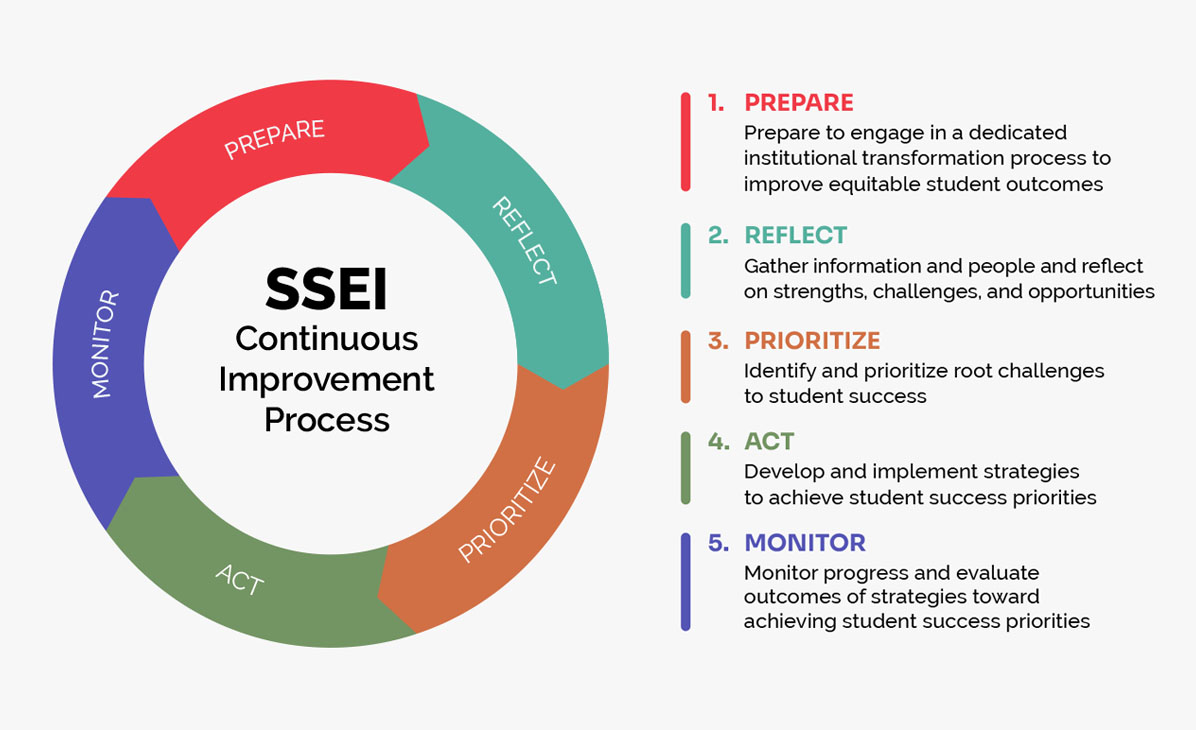
    SSEI Continuous Improvement Process

    This cohort experience accelerates transformation by providing targeted, customized support to help institutions use data to remove barriers and improve outcomes for students who have been historically underserved. Participant objectives include:

    Work with subject matter experts in data analytics, student success, advising, institutional transformation, and strategic and systems planning:

    • Collaborate with other institutions to uncover shared challenges and solutions to improving outcomes for all students.
    • Collaborate with cross-campus teams to develop, articulate and act on a shared vision for student success and prioritized action plan.
    • Recognize individual strengths and growth opportunities to build the long-term ability to contribute to transformation.

    Take an integrated, student-centered, comprehensive approach to transformation:

    • Leverage a continuous improvement process to make informed, data-driven decisions grounded in the reality of students.
    • Develop a clear, shared purpose that helps everyone see their role in making the institution more responsive to student needs.
    • Hear success stories from other campuses and experts in the field and understand how to apply learnings to their own context.

    One of the cornerstones of AASCU’s student success efforts is our emphasis on engaging senior leaders in key positions at participating institutions as a student success team.

    Team members work together to understand and elevate student experiences, review data to inform student success strategies aligned with institutional strengths and growth opportunities and engage others on their campus in transformation.

    Each participating institution has assembled a campus team consisting of at least the following required roles: President, Campus Team Lead, Provost, Data Lead.

    Program Structure
    • 55 institutions participating in a multi-year, team-based learning journey focused on student success
    • Blended convenings (in-person and virtual) for connecting with content experts and collaborating across cohort teams
    • Strategic, institution-specific coaching from AASCU to support goal alignment and long-term sustainability
    • Access to a robust suite of tools, resources, templates, subject-matter experts, and a peer learning community

    Moving forward, the program will emphasize:

    • Reflective sense-making grounded in data
    • Strategic delivery of technical assistance
    • Facilitation of cross-cohort learning and collaboration
    Our Impact

    Transforming Systems, Elevating Futures

    By focusing on SSEI’s 5 pillars, participating institutions are making upward mobility a reality for more students.

    55

    institutions enrolling 585,827 students

    100%

    of institutions have median student earnings that exceed those of the average high school graduate in their state and allow students to earn back the cost of their college education

    41%

    of students enrolled at participating institutions are Pell-eligible

    62%

    of institutions have median student earnings that allow them to move into the upper-middle income quintile

    “It’s not often we have time to sit around a table and really dig into data and look at different policies and research to make a change at our institution. It was really helpful to have team time coupled with experts and emerging research.”

    Michelle Eaton

    Executive Director, Student Retention and Success
    University of North Georgia

    Our Partners In This Experience

    AASCU is connected to a network of content and subject matter experts, from advising to strategic finance. Here are some of the partners that participating institutions would have access to as part of the experience.
    Questions about the SSEI Initiative? Let us know.

    "*" indicates required fields

    Alumni Outcomes Data Collaborative

    Supported by the Gates Foundation, AASCU is thrilled to bring the National Alumni Career Mobility Survey (NACM) to member institutions committed to improving postsecondary value by understanding their alumni’s post-graduation outcomes.

    Learn more.

    Improve postsecondary value by learning more about your alumni post-graduation outcomes.

    The Alumni Outcomes Data Collaborative is a unique opportunity open to five member campuses committed to improving postsecondary value by gaining a thorough understanding of their alumni economic mobility and career outcomes five- and 10-years post-graduation. Supported by the Gates Foundation, the selected a five-campus cohort, representative of AASCU’s membership, will conduct the National Alumni Career Mobility survey (NACM) fall 2024. Participating institutions will receive extensive technical assistance and guidance from the NACM research team at no cost to the institution, including alumni communications, launching and administration of the survey, data analysis and interpretation, and presenting results and recommendations to key campus stakeholders. AASCU’s synthesis from the cohort’s experience will be made available to all members in 2025.

    NACM Survey Focus Areas:
    1. Career Insights
    2. Economic Mobility
    3. Education Satisfaction
    4. Career Satisfaction
    5. Learning Outcomes and Experiences
    6. Community Engagement
    7. Postsecondary Value

    Leveraging Alumni Voices to Drive Value - A Starter Kit for Campus Leaders

    AASCU published a paper on this work in September 2025.

    Learn more.

    2024 participants:

    • East Tennessee State University
    • Indiana University (Kokomo, Southeast, Northwest, South Bend, and East)
    • Oakland University
    • California State University, Dominguez Hills
    • University of Maryland Eastern Shore

    Benefits of participation:

    • Insight into alumni educational experiences and economic mobility post-graduation for the purposes of improving equitable postsecondary value
    • Opportunity to participate in a cohort of five AASCU member institutions representing a cross-section of AASCU membership and be a part of the Alumni Voices Capstone project that will be presented at the 2025 AASCU Annual Conference
    • Technical assistance and support from beginning to end in conducting the NACM survey, including onboarding and survey administration, data analysis and interpretation (“data storytelling” to share with key stakeholders), interactive dashboard, raw data file, slide deck with key findings, and key findings final written report

    Applications are closed.

    • Identification of a cabinet-level Campus Champion to secure executive-level approvals needed to move project forward
    • Identification of a campus project manager who will oversee and shepherd the project at the campus level. The project manager will provide administrative support as needed:
      • Serve as primary campus contact for AASCU and NACM administrators
      • Lead all campus marketing and messaging efforts related to the NACM Survey
      • Consult with key campus stakeholders and maintain Campus Champion up to date on NACM survey developments
      • Participate in NACM survey onboarding meeting, midpoint meeting, and partner’s forum (dates TBD)
    • Participate in AASCU cohort meetings as invited and capstone symposium (dates TBD)
    • Timely review and decisions by the university on key milestones and deliverables.
    • Agreement to share unidentifiable NACM survey findings and action items as a public resource

    Please contact Leticia Maldonado with questions about the Alumni Outcomes Data Collaborative.
    Alumni Outcomes Data Collaborative Partner

    Questions about the Alumni Outcomes Data Collaborative? Let us know.

    "*" indicates required fields

    Strategic Planning Collaborative

    Develop a strategic roadmap for the institution’s strategic plan that leverages promising practices and reflects a commitment to student outcomes.

    Contact us.

    Leverage promising practices to further advance your university’s strategic priorities and desired outcomes.

    Senior consultants from AASCU Consulting will support and facilitate processes and serve as the connective tissue between the Postsecondary Value Commission Action Agenda and participating institutions to develop a strategic roadmap for the university strategic plan that leverages promising practices and reflects the institution’s commitment to student outcomes.

    AASCU Consulting will review the desired outcomes and targets the university identified (or will identify if the strategic plan is in development) to assess alignment with advancing the pathway to postsecondary value – access, affordability, support, completion, and career outcomes. AASCU Consulting will present promising practices that align with and can advance the desired outcomes and facilitate discussions on strategies, actions, and needed capabilities to pursue them.

    2026 cohort:

    • California State University, Los Angeles
    • Eastern Oregon University
    • Indiana University Southeast
    • Northern Michigan University
    • Northwestern Oklahoma State University
    • Shawnee State University (OH)
    • SUNY Oneonta
    • University of Arkansas at Pine Bluff
    • University of Illinois Springfield
    • University of Nebraska at Omaha

    Benefits of participation:

    • Develop a strategic roadmap for the university strategic plan that leverages promising practices and reflects the institution’s commitment to student outcomes
    • Receive promising practices that align with and can advance the desired outcomes and facilitate discussions on strategies, actions, and needed capabilities to pursue them
    What to Expect
    • Willingness and commitment from top leadership to implement and manage change.
    • Organizational culture that can sustain strategy. “Ready institutions” have organizational cultures that may not completely support planning processes, but also do not undermine or immediately dismantle them.
    • University leadership should be stable meaning that the president/chancellor and provost—at a minimum—are not actively seeking new positions elsewhere and see themselves at the current institution for the near future.
    • History of realigning expenses with revenues (or seeking new revenues) to ensure that strategic plans are appropriately funded.
    • History of success in developing and implementing strategic planning processes that affect change, including managing dashboards where results are showcased.
    • Regular access and contact with the president and leadership team throughout the process.
    • Timely review and decisions by the university on key milestones and deliverables.
    • An on-site project coordinator to provide administrative support as needed:
      • Provide information
      • Set up meetings
      • Distribute agendas
    • Make timely payment of fees and expense reimbursements.
    • Participate in convenings as invited.
    • Agree to share your strategic roadmap as a public resource.

    Please contact Matt Ceppi with questions about the Strategic Planning Collaborative.

    Guidebook for Campus Leaders

    AASCU has developed a leadership guidebook that higher education institutions can use to help assess their readiness for integrating the Postsecondary Value Commission’s Postsecondary Value Framework (PVF) in their strategic plan. This guidebook is based on the experiences of the initial Strategic Planning Collaborative—a set of five AASCU member institutions.

    2024 Strategic Planning Collaborative participants:

    • Bemidji State University
    • San José State University
    • State University of New York at Oswego
    • Stockton University
    • Montclair State University

    Strategic Planning Collaborative Partner

    Questions about the Strategic Planning Collaborative? Let us know.

    "*" indicates required fields