Aspen – AASCU Transfer Student Success Intensive

An initiative to support partnerships between community colleges and AASCU members in advancing the practices and policies associated with improved transfer student success.

Contact us.

A community of practice focused on transfer outcomes.

The Aspen – AASCU Transfer Student Success Intensive, funded by Ascendium Education Philanthropy, is a one-year initiative of monthly sessions designed to support partnerships between community colleges and AASCU members in advancing the practices and policies associated with improved transfer student success. The institutions receive one-on-one consulting with experts, and work to identify, collect, understand, and utilize critical transfer outcomes and data to develop a forward-looking strategic transfer plan.

Team Design

  • AASCU institutions partnered with up to two community colleges committed to participating in the entire year-long initiative
  • Campus teams consist of the following required roles:
    • President
    • Cabinet-level lead
    • Project management lead
    • Institutional research office representative
    • Faculty representative
    • Representative responsible for transfer functions

Benefits of the Transfer Intensive

  • A yearlong, 12-part, virtual series of strategy-focused workshops based on the Aspen Institute and Community College Research Center (CCRC) Transfer Playbook and other transfer research
  • Four hours of free consulting to support your transfer efforts
  • Support to identify, understand, collect, and utilize critical disaggregated transfer data
  • A national community of practice, focused on elevating excellence in transfer reform
  • Elevation of your institution’s transfer success reforms, stories, and successful practices on Aspen and AASCU media and communication platforms
What to Expect
Community College Representatives
  • President of the four-year institution/s. As part of their commitment to the Intensive Presidents will:
      • Attend all four presidential sessions.

    Convene with their partner president outside of Intensive sessions to set a concrete partnership vision statement Review initial transfer data and support the collection of future data needed to track progress toward short and long-term transfer goals Approve the model/s, goals, reform priorities, Strategic Transfer Excellence Plan (STEP), and funding to support the STEP Communicate with internal and external stakeholders about the STEP and the value of transfer students to the institution Share transfer goals and value of transfer students to the institution/s through joint statement with partner president, community appearances, regional op-eds, etc.

  • Cabinet-level lead from four-year institution/s. As part of their commitment to the Intensive Cabinet-level leads will:
    • Attend all Intensive sessions.
    • Facilitate team activities during each session.
    • Connect regularly with their counterparts, project managers, and core team members between sessions to ensure they are on track and ready for each session
    • Align the team’s goal and practice reform priorities with the president’s vision
    • Generate alignment among key leaders and stakeholders on their respective campuses.
    • Guide presidential and board commitments to the Intensive
    • Lead the execution of the Strategic Transfer Excellence Plan (STEP)
    • Lay solid foundations for effective communication and governance across partnerships
  • Project management lead from four year institution/s -preferably with direct responsibility for transfer (e.g., a director of transfer, transfer advisor, transfer coordinator). *Please note: this role requires strong organization, coordination, and administrative skills. As part of their commitment to the Intensive project managers (PM), leads will:
      • Attend all Intensive sessions Manage team communications across the partnership/s and with the Aspen/AASCU Team.

    Manage team materials, notes, and assignments in the shared Google Drive Coordinate internal and external meetings between partner presidents, stakeholders, and/or the Aspen/AASCU Team Work in partnership with cabinet leads to align vision and operations Manage the development and finalization of the Strategic Transfer Excellence Plan (STEP), including submitting the STEP to the Aspen/AASCU Team

  • Institutional research office representative from the four-year institution/s
    • This representative will also attend an IR onboarding session before the Transfer Intensive Kickoff to better understand the transfer data teams will be working with. The IR rep from the community college and the four-year institutions should also expect to meet outside of monthly sessions to confer on transfer data alignment.
  • Faculty representative from the four-year institution/s
    • The best representative for this role is a current faculty transfer champion and supporter on your campus. Perhaps a dean, department chair, faculty senate representative, etc.
  • One-to-two other representatives from the four-year institution/s that have direct responsibility for transfer functions at the institution/s
    • The best representative/s for this role/s would be a transfer center director, advising, registrar, financial aid, student affairs representative, or others who are working with transfer students regularly, etc.;
  • In addition to those required to attend all sessions, other campus representatives are invited to specific sessions based on their institutional role and session topic.
Four-Year Institution Representatives
  • President of the four-year institution/s. As part of their commitment to the Intensive Presidents will:
      • Attend all four presidential sessions.

    Convene with their partner president outside of Intensive sessions to set a concrete partnership vision statement Review initial transfer data and support the collection of future data needed to track progress toward short and long-term transfer goals Approve the model/s, goals, reform priorities, Strategic Transfer Excellence Plan (STEP), and funding to support the STEP Communicate with internal and external stakeholders about the STEP and the value of transfer students to the institution Share transfer goals and value of transfer students to the institution/s through joint statement with partner president, community appearances, regional op-eds, etc.

  • Cabinet-level lead from four-year institution/s. As part of their commitment to the Intensive Cabinet-level leads will:
    • Attend all Intensive sessions.
    • Facilitate team activities during each session.
    • Connect regularly with their counterparts, project managers, and core team members between sessions to ensure they are on track and ready for each session
    • Align the team’s goal and practice reform priorities with the president’s vision
    • Generate alignment among key leaders and stakeholders on their respective campuses.
    • Guide presidential and board commitments to the Intensive
    • Lead the execution of the Strategic Transfer Excellence Plan (STEP)
    • Lay solid foundations for effective communication and governance across partnerships
  • Project management lead from four year institution/s -preferably with direct responsibility for transfer (e.g., a director of transfer, transfer advisor, transfer coordinator). *Please note: this role requires strong organization, coordination, and administrative skills. As part of their commitment to the Intensive project managers (PM), leads will:
      • Attend all Intensive sessions Manage team communications across the partnership/s and with the Aspen/AASCU Team.

    Manage team materials, notes, and assignments in the shared Google Drive Coordinate internal and external meetings between partner presidents, stakeholders, and/or the Aspen/AASCU Team Work in partnership with cabinet leads to align vision and operations Manage the development and finalization of the Strategic Transfer Excellence Plan (STEP), including submitting the STEP to the Aspen/AASCU Team

  • Institutional research office representative from the four-year institution/s
    • This representative will also attend an IR onboarding session before the Transfer Intensive Kickoff to better understand the transfer data teams will be working with. The IR rep from the community college and the four-year institutions should also expect to meet outside of monthly sessions to confer on transfer data alignment.
  • Faculty representative from the four-year institution/s
    • The best representative for this role is a current faculty transfer champion and supporter on your campus. Perhaps a dean, department chair, faculty senate representative, etc.
  • One-to-two other representatives from the four-year institution/s that have direct responsibility for transfer functions at the institution/s
    • The best representative/s for this role/s would be a transfer center director, advising, registrar, financial aid, student affairs representative, or others who are working with transfer students regularly, etc.;
  • In addition to those required to attend all sessions, other campus representatives are invited to specific sessions based on their institutional role and session topic.
Team attendance/participation
  • Presidents of all participating institutions must attend the four presidential sessions
  • Project managers (PM) and cabinet lead representatives from all participating institutions should expect moderate follow-up and/or pre-work outside the monthly intensive sessions.
    • Pre-and-post-session work should include, but is not limited to:
      • routine discussion with partner PM, cabinet lead, and core team members between sessions to ensure the team is on track and ready for each session,
      • follow up with presidential and board commitments based on the Intensive participant project plan,
      • optional office hours with Aspen/AASCU staff for continued professional development, peer consultancy, and knowledge sharing;
      • in addition, PMs must attend a training session before the Intensive Kickoff
  • Other transfer intensive team members must attend all monthly sessions.
Time and discussion for transfer data collection
  • Aspen/AASCU will provide teams with strategies for collaborating with their institutional research office to obtain critical metrics for transfer student success outcomes per research-based practices.(Aspen/AASCU will provide a data report and a goal-setting template.)
  • IR representatives must attend a training session before the Intensive Kickoff.
Time and discussion for student feedback and insights
  • Aspen/AASCU will provide teams with strategies and sample questions for leading student focus groups while participating in the Intensive.
Four hours of free consulting with transfer experts
  • Institutions will be required to participate in at least two hours of consulting (either as a partnership team or individually as an institution) to address specific concerns within the year-long program

Thanks to the generous support of the Ascendium, there is no cost of participation.

Program Impact

The 41 institutional teams in cohorts 1-3 reached:

23

U.S. states

91

colleges and universities

1.1M+

undergraduates served annually​

16K+

transfer students per year

The 10 institutional teams in cohort 4 reach:

3

states not previously represented

6

Hispanic-Serving Institutions

4

Asian American and Native American Pacific Islander-Serving Institutions

1

Alaska Native and Native Hawaiian-Serving Institution

4

Rural-Serving Institutions

39.7%

of the cohort’s enrollment is comprised of Pell grant recipients

Cohort 4 (2025-2026)
State 4-Year Institution 2-Year Partner
CA California State University, Fullerton Fullerton College
CO Metropolitan State University of Denver Community College of Denver
HI University of Hawaii-West Oahu Kauai Community College
Honolulu Community College
ID Idaho State University College of Southern Idaho
ME University of Southern Maine Southern Maine Community College
NC University of North Carolina-Charlotte Central Piedmont Community College
NY Queens College, CUNY LaGuardia Community College
Queensborough Community College
OR Portland State University Portland Community College
PA Slippery Rock University Butler County Community College
Community College of Beaver County
TX University of Houston-Downtown College of the Mainland


Our Partner

Supported by

Questions about the Transfer Student Success Intensive? Let us know.

"*" indicates required fields

SSEI Initiative

This multi-year cohort experience helps regional public universities adapt and evolve to meet the unique needs of current and future students.

SSEI

We help our members accelerate change where it matters most.

SSEI is a cohort-based learning community that fosters connection, accountability, and shared learning. Cross-functional campus teams—including students, faculty, staff, administrators, and senior leaders—work together to create conditions where every student can thrive.

AASCU’s SSEI cohort talks about plans for transforming policies that stand in the way of student progress.

Program Participants

Thanks to the generous support of the Gates Foundation, 55 institutions enrolling over 500k students have been able to participate in SSEI at no cost to them.

+
Guam
Puerto Rico
U.S. Virgin Islands
Bahamas
Canada
Mexico

    The Experience

    A transformative approach rooted in history and evidence.

    For over 50 years, AASCU has partnered with regional public universities to expand access to affordable, high-quality education and support the communities they serve. In 2016, we began documenting how our most successful member institutions made real progress. Through listening, research, and data analysis, we’ve identified a set of core practices that consistently drive lasting change. These pillars are the foundation of SSEI:

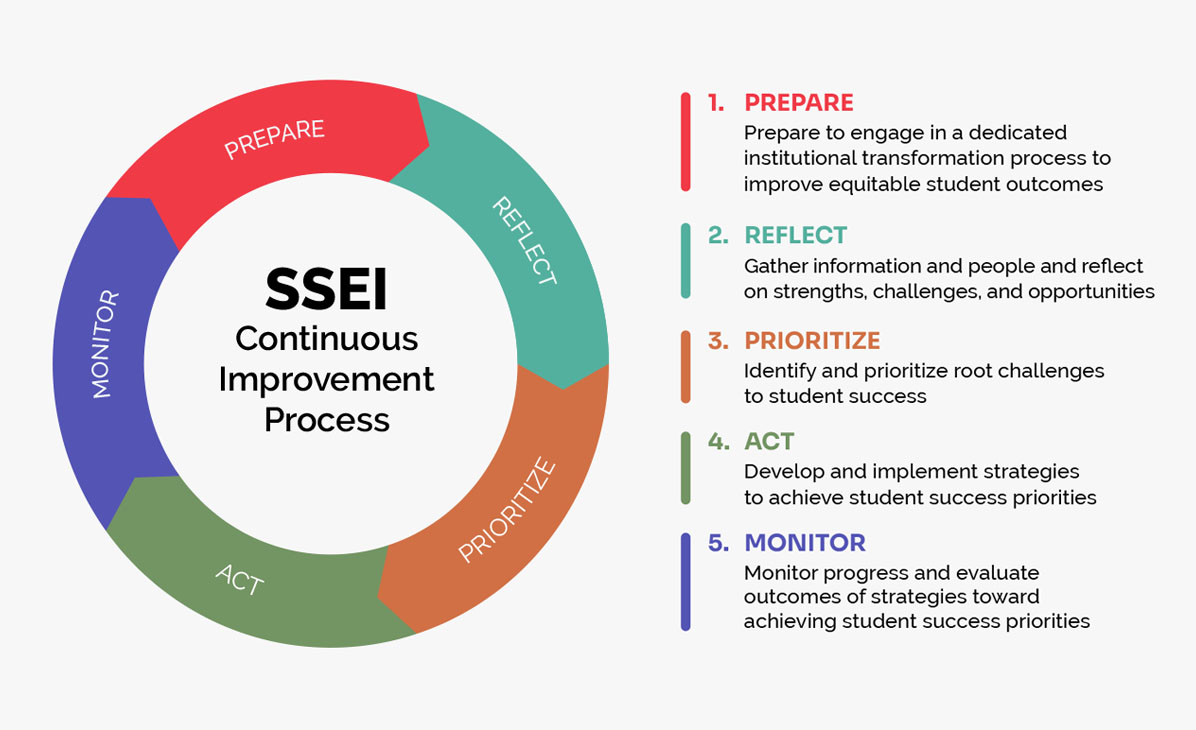
    • A process of continuous improvement
    • A culture of evidence and assessment
    • Integrated student-centered structures, processes, and supports
    • Engagement with community and regional stakeholders
    • A culture of shared leadership and vision

    Continuous improvement—the AASCU way.

    Shaped by insights from more than 70 member institutions, national experts, and support from the Gates Foundation, our 5-step continuous improvement process gives teams the structure, tools, and expert guidance to strengthen the foundations of lasting institutional change.

    SSEI Continuous Improvement Process

    This cohort experience accelerates transformation by providing targeted, customized support to help institutions use data to remove barriers and improve outcomes for students who have been historically underserved. Participant objectives include:

    Work with subject matter experts in data analytics, student success, advising, institutional transformation, and strategic and systems planning:

    • Collaborate with other institutions to uncover shared challenges and solutions to improving outcomes for all students.
    • Collaborate with cross-campus teams to develop, articulate and act on a shared vision for student success and prioritized action plan.
    • Recognize individual strengths and growth opportunities to build the long-term ability to contribute to transformation.

    Take an integrated, student-centered, comprehensive approach to transformation:

    • Leverage a continuous improvement process to make informed, data-driven decisions grounded in the reality of students.
    • Develop a clear, shared purpose that helps everyone see their role in making the institution more responsive to student needs.
    • Hear success stories from other campuses and experts in the field and understand how to apply learnings to their own context.


    One of the cornerstones of AASCU’s student success efforts is our emphasis on engaging senior leaders in key positions at participating institutions as a student success team.

    Team members work together to understand and elevate student experiences, review data to inform student success strategies aligned with institutional strengths and growth opportunities and engage others on their campus in transformation.

    Each participating institution has assembled a campus team consisting of at least the following required roles: President, Campus Team Lead, Provost, Data Lead.

    Program Structure
    • 55 institutions participating in a multi-year, team-based learning journey focused on student success
    • Blended convenings (in-person and virtual) for connecting with content experts and collaborating across cohort teams
    • Strategic, institution-specific coaching from AASCU to support goal alignment and long-term sustainability
    • Access to a robust suite of tools, resources, templates, subject-matter experts, and a peer learning community

    Moving forward, the program will emphasize:

    • Reflective sense-making grounded in data
    • Strategic delivery of technical assistance
    • Facilitation of cross-cohort learning and collaboration
    Our Impact

    Transforming Systems, Elevating Futures

    By focusing on SSEI’s 5 pillars, participating institutions are making upward mobility a reality for more students.

    55

    institutions enrolling 585,827 students

    100%

    of institutions have median student earnings that exceed those of the average high school graduate in their state and allow students to earn back the cost of their college education

    41%

    of students enrolled at participating institutions are Pell-eligible

    62%

    of institutions have median student earnings that allow them to move into the upper-middle income quintile

    “It’s not often we have time to sit around a table and really dig into data and look at different policies and research to make a change at our institution. It was really helpful to have team time coupled with experts and emerging research.”

    Michelle Eaton

    Executive Director, Student Retention and Success
    University of North Georgia

    Our Partners In This Experience

    AASCU is connected to a network of content and subject matter experts, from advising to strategic finance. Here are some of the partners that participating institutions would have access to as part of the experience.

    Questions about the SSEI Initiative? Let us know.

    "*" indicates required fields